
Can this new technology revolutionise eczema care?
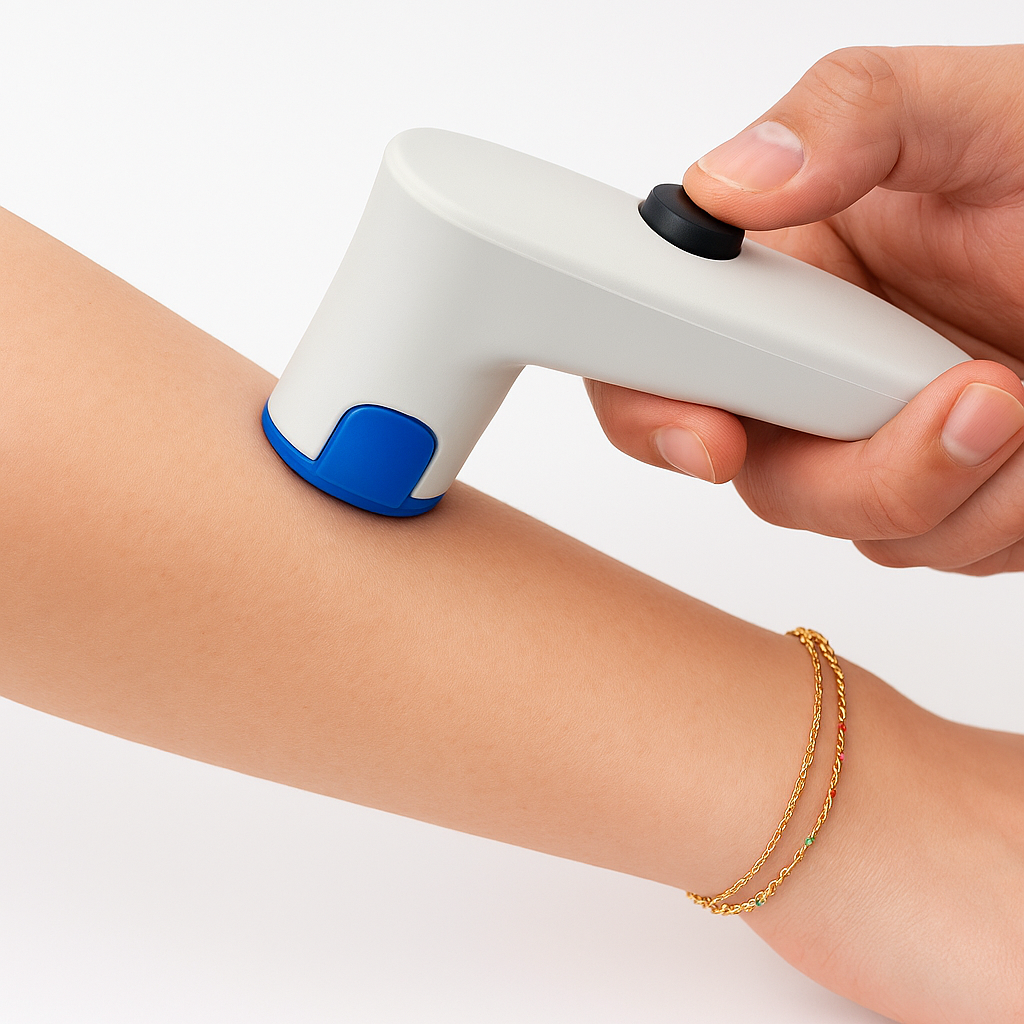
Last week members of our Experts by Experience group listened to Michael Crichton and his colleagues from Heriot-Watt University describe a new skin sensor technology that they hope will make it quicker and easier to diagnose and test for eczema in the skin. Read his full blog post below.
For many people with eczema, the care journey follows a familiar pattern. A visit to the GP leads to emollients or steroid creams, followed by a waiting period of six weeks or more to see if the treatment works. When it doesn’t, the patient returns and the cycle begins again. This trial-and-error process can stretch for months or even years. For those referred to a dermatologist, waiting times often exceed twelve months, after which further cycles begin with stronger treatments.
Patients consistently describe this experience as frustrating and unsupported. The root of the problem is not a lack of clinical care, but a lack of tools. Without a way to rapidly assess whether a treatment is working, doctors must rely on drawn-out cycles of guesswork and observation.
At Heriot-Watt University, we are developing a new sensor technology to address this long-cycle process. Our handheld device works like an ear thermometer, but instead of measuring temperature, it uses harmless soundwaves to assess changes in the barrier strength and inflammation of the upper skin layers – precisely where eczema manifests. The scan takes only seconds.
Because the technology uses sound rather than optics or cameras, it also removes skin tone bias, offering a fairer and more accurate assessment for all patients.
The device is currently undergoing clinical testing. Early indications suggest it could perform as well as a dermatologist’s expert visual assessment. The next step is to spin out a company, TissueMetrics, to build a commercial product that can be placed in pharmacies, enabling eczema care to be supported directly within the community.
The vision is straightforward: a patient visits a pharmacy, receives a rapid skin measurement, tries an emollient for just one week, and returns to confirm whether the treatment is likely to work in the longer term. This would compress what is often years of treatment optimisation into weeks, improving quality of life and giving patients more control over their skin health journey.
With over 300 million people globally affected by inflammatory skin conditions, the need for faster, fairer, and more effective support is clear. This technology will not replace clinicians, but it will give them – and patients – a better way forward.
Edit: We were delighted to see that the skin sensor and the work of Michael and his team got nationwide media coverage, being featured in ITV news. You can read the article here.
.png)
.png)